
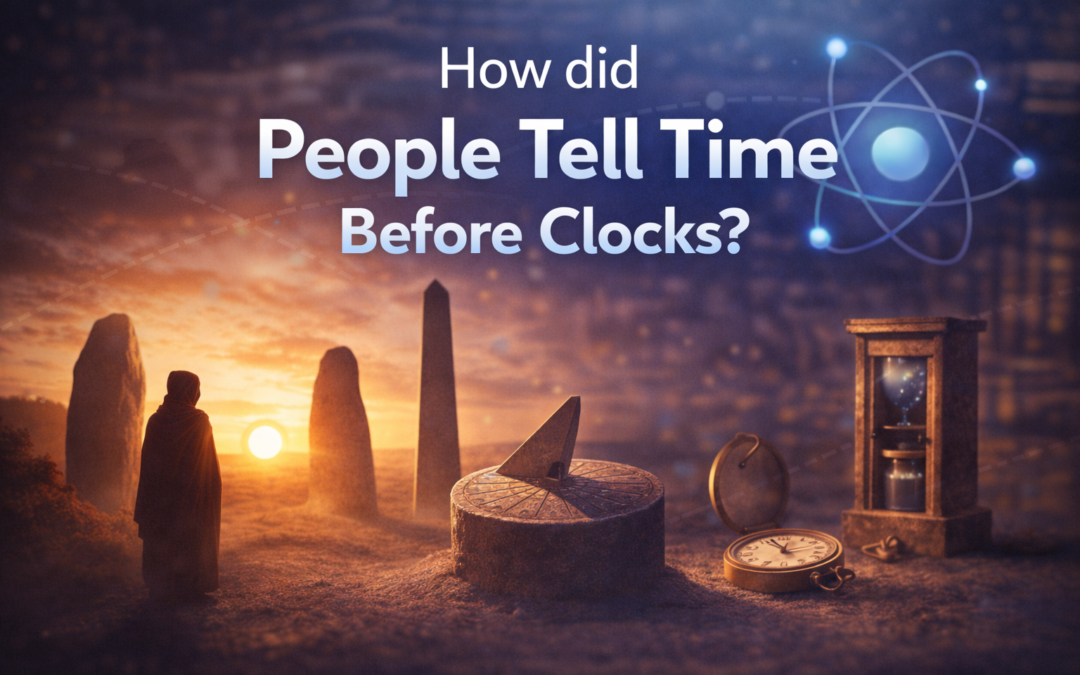
Before wristwatches, you still had deadlines, meetings, and long workdays that needed structure, especially in farming, religion, trade, travel, and growing cities that depended on routine. You handled that by reading reliable motions in nature, then using shadows, star paths, water flow, and engineered rhythms to create repeatable time signals that other people could share, compare, and trust.
In this article, you will trace each method from observation to device, learn where it stayed inaccurate, and see how the demand for shared schedules, fair pay, and safer travel shaped modern standard time.
Watching the sky was the first time system
You could estimate time by tracking where the sun sits between sunrise and sunset, then checking how fast the light changes. You also used the moon and bright stars to judge whether it was early night, midnight, or close to dawn. This gave you usable direction for daily life, but it never delivered exact minutes because the weather, latitude, and season change what you see.
Sun position, moonlight, and seasonal hours
You learned quickly that daylight length is not constant, so an “hour” could stretch in summer and shrink in winter when time was tied to daylight.
That is why many communities treated time as a flexible guide for chores, prayer, and trading, not a fixed number on a dial. Once travel and commerce demanded tighter coordination, you needed tools that produced the same answer on different days, not just a reasonable guess.
Sundials turned sunlight into repeatable time
When you needed a clear daytime schedule, you used a sundial or shadow clock that converts the sun’s motion into a moving shadow. Ancient examples are often linked to Egypt and Mesopotamia, and an Egyptian shadow clock is commonly dated to around 1500 BCE. You read time by watching the shadow cross markings that represent intervals through the day.
Why sundials needed smarter geometry
You noticed that the shadow behaves differently across seasons, so early dials could drift unless you adjusted for the sun’s changing path. You improved consistency by aligning the gnomon with Earth’s axis, which helps create equal hours throughout the year instead of seasonal hours. That design choice explains why many later sundials use a slanted gnomon, since the angle makes the shadow track more predictable across months.
Nighttime timekeeping depended on the stars
When daylight disappeared, you used the sky as a clock face by tracking bright stars and familiar constellations. You could compare a star’s position to the horizon or a known line in the landscape, then estimate how much of the night had passed.
This method required clear skies and practice, but it worked anywhere you could see the heavens.
The merkhet made the night measurable
In ancient Egypt, you could use tools such as the merkhet to align observations with the pole star and track star movement more consistently. By watching when certain stars crossed a reference line, you could estimate time passage during the night without guessing based on darkness alone.
This mattered for temple rituals, early travel, and farming tasks because you often needed reliable timing before sunrise and after sunset, not just at midday.
Water clocks measured time without sunlight
If you needed timekeeping indoors, at night, or during heavy cloud cover, you relied on water clocks, also called clepsydrae. These devices measure time by controlling water flow, either by tracking water leaving a vessel or water entering one. Because flow can be steady over long periods, you gained a continuous measurement that did not depend on a visible sun.
Inflow and outflow designs and their limits
You could build an outflow clock by letting water drain through a small hole and marking the changing level as it drains against elapsed time. You could also build an inflow clock by letting water fill a container and reading a rising level against marks, which was often easier to see in low light.
Both designs faced practical issues, including freezing, evaporation, and changing pressure that alters the flow rate, so you frequently recalibrated against solar observations.
Hourglasses delivered trustworthy intervals
When you wanted to measure a fixed duration, you used an hourglass, which times an interval rather than the time of day. Historical records place hourglasses in Europe by the 1300s, and they became popular on ships because sand keeps flowing even when the sea is rough. You did not use an hourglass to find noon, but you relied on it to repeat a task in the same amount of time.
Why interval timing mattered at sea and at work
You could flip an hourglass to regulate watches, cooking, or scheduled duties, then repeat the cycle with the same rhythm all day. On ships, interval timing supported navigation routines and watch changes, which reduced confusion and fatigue in high-stakes conditions. If you manage schedules across regions now, using a World Time Zone calculator gives you the same advantage of repeatable intervals and shared reference points without relying on memory.
Mechanical clocks made time a public standard
Mechanical clocks grew in medieval Europe and became central when communities needed shared schedules for work and worship. You saw early large installations in towers and churches, where bells announced time to people who owned no personal device. These early machines were not perfectly accurate, but they changed life by making time public, enforceable, and shared.
Escapements created controlled ticking
You gained dependable mechanical timekeeping when inventors used escapements to release stored energy in regular steps. Weight-driven systems, and later spring-driven systems, turned stored power into motion, while the escapement regulated the motion into countable beats. Even so, drift accumulated, so you often reset early clocks using sundials or local solar cues because a small daily error could grow into a serious scheduling problem.
Portable watches arrived before true minute accuracy
Once you wanted time in your pocket, you moved from large clocks to spring-powered portable watches. Early portable watches appeared in Europe by the late 1400s, yet many displayed only hours because stability was limited. You could carry the device, but you could not always trust it for fine, minute-level coordination.
Smoothing spring power improved precision
A spring does not deliver uniform force as it unwinds, so accuracy suffers unless you manage that changing power. Designers introduced ways to smooth torque, including fusee systems that compensate for shifting spring tension across the run. That engineering shift matters because you cannot justify minute and second markings until the motion behind the hands stays consistent, and consistent motion is what turns a novelty into a dependable daily tool.
Local time worked until travel sped up
Before standard time, your local “noon” was when the sun peaked, and it shifted as you traveled east or west. Even short trips could shift local time by several minutes, which rarely mattered when travel was slow and communication was limited. As transportation accelerated, those small differences turned into missed connections, late arrivals, and dangerous confusion.
Time zones solved a growing coordination problem
Railroads needed shared time because schedules require a common reference, especially on routes that cross many towns. In North America, railroads adopted standardized time zones in 1883, and wider adoption followed as governments and businesses aligned around the same system. If you want the logic behind the system you use daily, the explanation in why do we have time zones ties public safety and scheduling pressure to the structure of modern standard time.
The 1800s pushed accuracy into daily life
In the 1800s, timekeeping moved into more homes as manufacturing expanded and communities demanded dependable schedules. You saw pendulum clocks in schools, stations, offices, and living rooms, and you treated them as both practical tools and symbols of stability. You still maintained them carefully, because leveling, winding, temperature, and humidity could affect performance.
Railroad service raised the bar for watches
Timetable travel changed what “accurate enough” meant, because small errors could create major risk on busy rail lines. Discussions of railroad reform often cite an 1891 collision linked to mismatched timekeeping, which helped push tighter watch standards for certain employees. Today, your phone attempts automatic synchronization, and the guide on will my phone automatically change time zones shows what can go wrong when devices fail to align.
Social cues filled gaps between devices
Even with devices, you still relied on social signals and routines to stay on time when precision tools were scarce. You listened for bells, watched public tower clocks, and planned around predictable sequences like meal breaks, shift changes, and market openings. In many places, time functioned as measurement plus agreement, not a private number everyone carried.
Practical strategies you could combine
You improved reliability when you paired more than one method, especially when weather or travel disrupted a single tool. These strategies appear across cultures because they are simple, resilient, and easy to teach. You can group them this way:
- Sun shadows for daytime structure
- Star positions for nighttime estimates
- Water flow for continuous indoor timing
- Hourglasses for repeatable intervals
- Bells and towers for shared community time
What pre-clock time teaches you today
The history of timekeeping shows a shift from observation to engineered consistency, driven by real human needs rather than curiosity alone. Each tool solved a specific problem, such as telling time at night, measuring an interval, or coordinating a whole town. When you focus on the pattern, you see that accuracy becomes valuable the moment other people depend on your timing.
A practical modern takeaway
You still face the same categories of time problems, just with better tools, including distance coordination and drift control. You reduce errors when you choose a shared reference system, use devices that synchronize, and build habits that catch mistakes early.
Understanding how time moved from shadows and stars to standardized zones helps you treat time as a system you manage, not a number you hope is correct.
Conclusion
You told time before clocks by observing the sun and stars, then by building devices that convert steady natural motion into measurable intervals, including sundials, water clocks, and hourglasses. You later depended on mechanical clocks and portable watches that regulated stored energy through controlled ticking, and you kept improving them because drift could disrupt pay, prayer, shipping, and safety on the road.
When you connect these methods to the rise of standard time zones, railroad scheduling pressure, and the spread of dependable household clocks in the 1800s, you can see how timekeeping evolved from local experience into a shared system that supports travel safety, organized labor, fair coordination, and clear expectations across the USA, and you see why communities valued public signals, why inventors fought friction and temperature, and why synchronization still matters when you cross borders or book flights.