
Introduction
Studying mathematics at home can often be a real challenge for many. In class, the teacher can immediately spot a mistake in reasoning or explain a difficult step. At home, however, the student is left alone with the task. That is why digital tools have become so popular. They promise support, structured practice, and feedback. Nevertheless, the mere fact of using technology does not guarantee progress. Only the purposeful use of digital tools with a clear focus on skill development can truly strengthen mathematical training. A successful home study strategy combines technology with proven learning approaches. This involves regular practice, error analysis, gradual complication of material, and the development of mathematical thinking.
Digital Resources with Clear Learning Goals
The effectiveness of any technology depends on how we use it. If a student simply solves random problems in an app without analyzing the results, their progress will be limited. Instead, start with a specific goal. This could be a target to improve skills in working with fractions. Or, maybe, to prepare for the algebra section of a standardized test.
Planning should include:
- Identifying weak areas;
- Setting a schedule for lessons;
- Regularly checking progress.
This is how technology math becomes a tool for development rather than entertainment.
Organizing a digital learning environment
Home schooling requires organization. Students need access to reliable platforms and devices that support focused study. Ones that make it easier to practice with interactive simulators, video explanations, and exercises with automatic checking. Special attention should also be paid to choosing the right smartphone for everyday learning tasks. A device with strong battery life, a clear display, and enough storage can make online lessons and educational apps much more convenient. If you are selecting a new phone for study and productivity, it helps to compare iPhone models to see which option best matches your needs, budget, and daily routine. This can simplify decision-making and help create a more efficient digital setup. It is equally important that the learning environment is not overloaded with distractions. Social networks, games, or unnecessary notifications during study time can significantly reduce the effectiveness of even the best educational tools.
Math Learning Apps Help Develop Test-Tested Skills. How Does This Work?
Most standardized math exams assess three key components:
- Computational accuracy;
- Problem solving;
- Logical reasoning.
Modern math learning apps can support each of these aspects when used correctly.
Problem-solving skills training
Text problems often cause difficulties. It is due to the need to translate a verbal description into a mathematical model. Online math learning platforms usually offer step-by-step explanations. These demonstrate:
– How to identify key information,
– How to formulate equations,
– How to check the answer.
It is helpful for students to first try to solve the problem on their own. Only then should they compare their approach with the suggested algorithm. Regular practice in a test format helps students get used to time constraints. This is an important factor for success on exams.
Developing computational accuracy
Regular practice of brief activities with rapid feedback helps to automate fundamental skills. When a student works on percentages, fractions, or equations on a daily basis, the number of common errors decreases. Apps with adjustable complexity raise the difficulty of tasks following a correct answer. This stimulates gradual progress. However, avoid mechanically clicking on answer options. After each mistake, analyze the explanation and try to repeat the solution on paper yourself.
The Role of Math Tablets in Homework
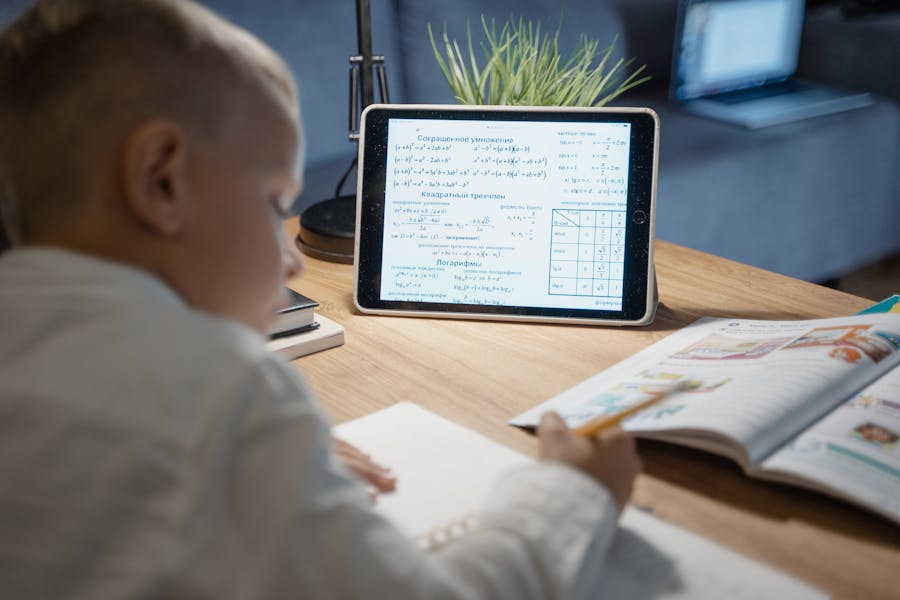
Math tablets can make learning more interactive. Touchscreens allow you to:
- Write formulas by hand;
- Build graphs;
- Take notes directly in the app.
These features are especially useful for geometry and algebra. There, visualization plays a key role.
Self-monitoring. Tracking progress
Many platforms allow you to track statistics on completed tasks. Students can see which topics need extra attention. Regular review of this data promotes conscious learning and planning for review.
Advantages of interactive visualization
Graphical tools help to better understand the relationships between variables. When students change the parameters of a function and immediately see how the graph transforms, abstract concepts become clearer. This approach promotes deep understanding rather than just memorizing formulas.
Assistive Technology for Math. Support Without Replacing Thinking
Assistive technology for math includes:
- Step-by-step hints;
- Adaptive algorithms;
- Solution verification tools.
For students with different levels of preparation, this can be a significant support.
DOs. How to use assistive technology correctly
- Use hints only after attempting to solve the problem yourself. In this way, you will remain actively involved in the thinking process.
- Use adaptive exercises to gradually increase the material’s difficulty level.
- To improve long-term memory, revisit previously studied topics on a regular basis.
DON’Ts. Common mistakes
- Relying solely on automated solutions or copying answers without comprehending the process.
- Using calculators to perform simple calculations if the purpose is to improve fundamental computational skills.
Technology should support learning rather than replace intellectual work.
Digital Tools with Proven Learning Strategies
Effective online math learning is based on combining technology with traditional methods:
- Keeping a notebook;
- Repeating formulas;
- Completing full tests.
Research in educational psychology confirms that active knowledge reproduction and interval repetition significantly improve results.
Students should schedule their sessions so that a portion of the time is dedicated to digital practice and the remainder to independent problem solving without hints. This balance will boost their confidence and prepare them for the actual test atmosphere. And in the latter, access to hints is limited.
Regular full practice tests help assess exam readiness. After each test, analyze mistakes in detail and identify the causes. Repeat the relevant topics using tools for math.
Conclusion
Digital tools open up a wide range of possibilities. Especially for strengthening math skills at home. However, their effectiveness depends on conscious use.
✔ Clearly defined goals.
✔ Regular practice.
✔ Analysis of mistakes.
✔ Combining technology with traditional methods.
All of the above creates the basis for sustainable progress.
Math learning applications, together with math tablets and assistive technologies, can considerably help students gain confidence in assessments when utilized to encourage active thinking. When students utilize math technology ethically and intelligently, they get a thorough mastery of the topic. This can form a solid foundation for future academic achievement.